Sample requirements
BL3.2Ua (PES) has two photoemission experimental stations using the synchrotron radiation. PES is for angle-resolved photoemission, and XPS is for angle-integrated photoemission. Sample requirements are different for each station. Basically, XPS is opened for those who want to measure spectra on many samples, including fine powders and large-sized materials, at room temperature. PES has a limited capacity for samples, but the in-situ heating and surface metal deposition are available.
ARPES Station
The sample is mounted on the holder (see a drawing below) by silver adhesive paste, and loaded into the 6-axis movable and cryo-cooled manipulator (Fermi instruments). A sample holder covered by a thermal radiation shield can be cooled down to 8 K from room temperature overnight. The Ar ion gun (3 keV) is also available for in-situ surface treatment.
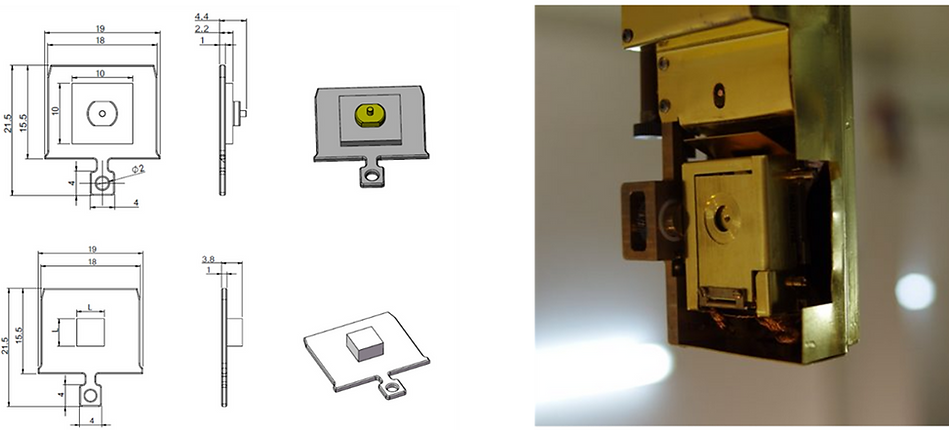
Sample requirements
-
The sample must be compatible with ultra-high-vacuum conditions
-
Cleavable material (usually a layered crystal structure) or single-crystalline material
-
The sample surface must be sufficiently conductive
-
The size of the sample should be more than 2-5 mm in diameter
Sample preparation
Samples have to be prepared in situ under ultra-high vacuum to produce clean, atomically controlled surfaces. In the vacuum system, the following techniques will be available:
-Cleavage of layered materials by knocking off a post-silver glued to the top surface.
-Ar ion gun sputtering (3keV@max energy)
-Annealing at separated MBE chamber

Top post cleavage preparation

ARPES end station sample holder

Data analysis
Data analysis software “Igor Pro” is available on PCs at the ARPES station. This is a commercial software licensed only at the station. Simple data analysis can be performed using Microsoft Excel 2007 (contact the beamline staff for the Microsoft Excel macro). Users are recommended to purchase the software either “Igor Pro” or “Origin” for further analysis in your office.
XPS Station
The sample is mounted on the stainless plate of 28 mm x 94 mm x 2 mm (thickness), sliding into the home-developed sample transfer mechanism based on the manipulator: HPT x-y, z translator. Sample surfaces should be conductive by either silver adhesive (12686-15: Silver Conductive Adhesive 503) or epoxy (H21D). Powder samples are attached on carbon adhesive tape (6mm x 20mm,). There are 2 slots for sample holders in the load-lock chamber. Samples loading duration before transfer to the measurement chamber is about 40 min., but it depends on your sample condition. For example, if the samples are powder shape, it takes at least one hour to load the samples into the analysis. The sample surface can be sputtered by a 3 keV Ar ion at most in-situ prior to XPS. No in-situ sample heater is available. A sample drain current can also be measured in NEXAFS mode.


Magic Angle NEXAFS Mode sample holder
Sample requirements
-
The sample must be compatible with ultra-high-vacuum conditions
-
The sample surface must be sufficiently conductive
-
The size of the sample should be more than 3 mm in diameter and less than 5 mm thick.
-The analytical area is about 1 mm x 1 mm.
-The proper size is about 5 mm x 5 mm, within 1 mm thick.
-
A control or standard sample should be prepared by users for reference.
Data analysis
Data analysis software “Avantage” is available on PCs at the XPS station. This is a commercial software licensed only at the station. Simple data analysis can be performed using Microsoft Excel 2007 (contact the beamline staff for the Microsoft Excel macro). Users are recommended to purchase the software either “Igor Pro” or “Origin” for further analysis in your office.


Contact the beamline staff for the Microsoft Excel macro
PEEM Station


