Research Highlight
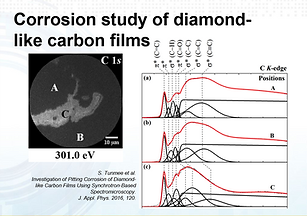
Investigation of Pitting Corrosion of Diamond-like Carbon Films Using Synchrotron-Based Spectromicroscopy
This study investigates why and how "pitting corrosion" (small holes or pits forming on the surface) occurs in Diamond-Like Carbon (DLC) films, which are typically used as protective coatings due to their hardness and chemical inertness.

Electronic and Thermoelectric Properties of Graphene on 4H-SiC (0001) Nanofacets Functionalized with F4-TCNQ
This study utilizes synchrotron-based photoemission electron microscopy (PEEM) and spectroscopy (ARPES) to investigate the electronic properties of epitaxial graphene on 4H-SiC substrates functionalized with the p-type dopant F4-TCNQ. The researchers discovered a significant inhomogeneity in charge transfer, where monolayer graphene on terraces exhibited a large work function shift of 0.7 eV, whereas the bilayer and trilayer graphene on nanofacets showed a much smaller shift due to different molecular adsorption configurations.

Quantitative NEXAFS and solid-state NMR studies of sp3/(sp2 + sp3) ratio in the hydrogenated DLC films
Diamond-Like Carbon (DLC) films are advanced coating materials that combine the extreme hardness of diamond with the low-friction properties of graphite. The mechanical performance of these films is determined by the ratio of graphitic (sp2) bonds to diamond-like (sp3) bonds within the structure. Researchers use NEXAFS spectroscopy to quantify this specific ratio by measuring the area of the pi* peak relative to the total peak area in the spectrum.

Spatial variation of the number of graphene layers formed on the scratched 6H–SiC(0001) surface
This study investigates how scratching the surface of a silicon carbide (SiC) substrate affects the growth of epitaxial graphene layers. The researchers used Low-Energy Electron Microscopy (LEEM) to count the number of graphene layers, identifying distinct regions of monolayer, bilayer, and trilayer graphene based on the number of dips in the electron reflectivity spectra. They found that thicker graphene layers (bilayer and trilayer) tend to form preferentially along the scratch lines and nanofacets, while the flat terraces are dominated by monolayer graphene.

Spectroscopic analysis of color origins in titanium-based thin films deposited by cathodic arc deposition
This research utilizes spectroscopic techniques like UPS, EELS, and NEXAFS to demonstrate that the color of titanium-based decorative coatings is primarily determined by the surface band gap. However, the study identifies key exceptions where "green" hues result from optical interference at the film-substrate interface, while "black" (TLB) films derive their color from specific chemical bonds (Ti-C and sp2 C=C) rather than the band gap mechanism. Ultimately, the findings emphasize that precise control over nitrogen content, film thickness, and surface roughness is critical for achieving consistent color reproducibility in industrial applications.

Ultraviolet-induced oxygen vacancy in SrTiO3
polycrystalline
The UPS spectrum of polycrystalline SrTiO3 is structurally different from single crystals (100, 110, 111), requiring Gaussian functions for peak fitting. This is due to the presence of an additional oxygen vacancy state and an oxide peak (2p), which are uniquely attributed to grain boundaries.

Directions and Breakup of Self-Running In Droplets on Low-Index InP Surfaces
This study investigates the unique phenomenon of "horizontal fabrication" on Indium Phosphide (InP) surfaces, where liquid Indium droplets spontaneously move across the substrate driven by chemical potential gradients rather than growing vertically. Unlike stable droplets in traditional nanowire growth, these "self-running" droplets often become unstable and break up into chains of smaller droplets, creating complex, branched etch trails. Crucially, the movement and breakup of these droplets are not random but are strictly governed by the underlying crystallographic structure of the InP surface.

Correlation between electron work functions of multiphase Cu-8Mn-8Al and de-alloying corrosion
This study investigates the corrosion mechanism of Nickel-Aluminum Bronze (NAB) alloys by employing Low Energy Electron Microscopy (LEEM) to map the work function of different microstructural phases. The researchers discovered that the beta phase exhibits a lower electron work function than the alpha phase, creating a significant electrical potential difference on the surface. This variation drives a micro-galvanic effect where the beta phase acts as an anode and undergoes preferential de-alloying corrosion, while the alpha phase remains relatively protected.